Friday, June 28, 2013

From Babi Yar to Jerusalem

This past Monday, I stood in Babi Yar, the infamous ravine in Kiev that became a killing field for nearly 34,000 Jews over the course of three days in September of 1941 at the hand of the German SS and local Ukrainians.

My guide for this difficult tour was Idan Peysachovich, a Siberian Jew who made aliyah in 1992 and now works for the Jewish Agency. Locally, the primary mission of the Jewish Agency is to strengthen both Jewish identity and build connectivity to Israel. Within minutes of meeting him, I felt an immediate bond with Idan, who informed me that the work he does is more than a job but entirely bound up in his personal life. He comes to his work on behalf of the Jewish Agency based on the journey he has undertaken as well as a sobering acknowledgement of the history of Jews in his native region.

As we walked towards Babi Yar, Idan told me that he is constantly engaged in the task of looking forward and backwards… at once. The forward glance he casts is towards the hopeful future he is building in Israel with his young family and two children who have rock solid Jewish identities. But he is compelled to look backwards also and contemplate the black pages of the Jewish experience in Kiev.

While Jews have been in Kiev since before the 11th century, there has always been an undercurrent of anti-Semitism in this part of the world, Idan told me. Russian princes would go through towns and let go of their pent-up feeling, looting villages and causing pogroms. These early pogroms culminated in the later pogroms of the 19th and 20th centuries. The pogroms in Odessa were especially fierce.

This was Idan’s way of contextualizing Babi Yar, his way of trying to explain the horror, the inhumanity; the sheer lunacy that led local Ukrainians to massacre their neighbors with their Nazi invaders over the course of three winter days more than seventy years ago.

Approaching the site, Idan wanted to make sure that I, an American Jew, born into the sanity and safety of the second half of the 20th Century, might come to understand where anti- Semitism and hatred can go when unchecked, where people can go when they lose their moral compass and people lose their bearings.

What struck me about Babi Yar is that it is a park, a ravine, in the middle of the city. That surprised me. Babi Yar is a park. It struck me that it could be Central Park. In the days before the massacre, Jews were told to show up with their belongings and papers and they did. They showed up, thinking they would get on a train to another city or be taken to a ship to Palestine or elsewhere.

They had no idea what awaited them.

Babi Yar – where tens of thousands of Jewish men, women and children were gunned down -- is a park. There’s an office building to one side. There are families strolling through it. I took a picture of a man sun bathing. The dissonance of past and presence overwhelmed me.

Idan told me that the doomed Jews encountered three rings of processing when they entered. First there were Ukrainians. Then Ukrainians and German soldiers, regular soldiers with German Shepherds and then, there were the SS Einsatzgruppen.

It was this last group that did the actual shootings into the ravine. Over three days, 34,000 Jews were shot and then thrown into the ravine. Afterwards, the Germans made the townspeople come and burn the bodies to destroy the evidence and protect against disease.

Here’s the thing. In the summer of 2013, Babi Yar seems so normal. I cannot get my head around it. Clearly, at the time of the mass murder of the Jews, the local people knew what was going on. They heard the shooting and the screaming even through the Germans played classical music very loudly and they helped, either in turning in families or in serving as guards or in simply turning a blind eye and allowing their neighbors to be butchered.

Today, there is not much to see in Babi Yar, but there is much to feel and to imagine: the terror of the victims; the cries and pleading and disbelief and desperate hope for a last-minute miracle; the horror of watching loved ones killed before your own eyes; the powerlessness of parents to save their children.

So, what remains of Babi Yar today? There’s a ravine. There’s a menorah and a platform where you can have a memorial ceremony, as we did. And there are the ghosts of the victims and their descendants, the millions of unborn Jews whose lives, as well, were taken by the Nazis.

Yet, it was very moving to be at Babi Yar with the Jewish Agency because thanks to their efforts, it is possible to stand at the very foot of the ravine and look forward with hope about Jewish life in Ukraine and the former Soviet Union.
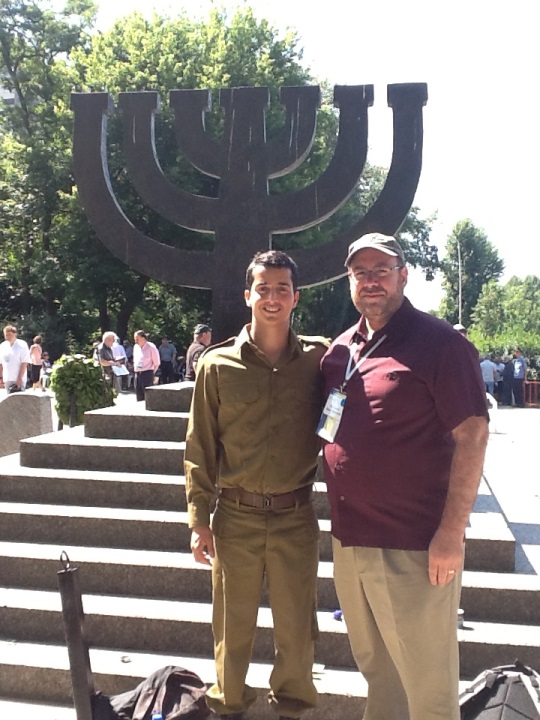
At the beautiful ceremony I attended, members of the IDF choir sang, Natan Sharansky and Israel’s Minister of Housing spoke, and one of the rabbis of the many local, newly-reinvigorated synagogues led the el maley rachamim prayer and kaddish.

A local young man also recited the words of a four-year-old survivor of Babi Yar whose entire family was betrayed by their nanny while he was inexplicably saved.

Among the songs performed by the IDF choir was Hatikvah.

Awash in so many dark feelings – sorrow, anger, fear of the modern-day anti-Semites now possessed with weapons of mass destruction – I tried to retain a sense of hopefulness.

What I found myself struggling with at Babi Yar was the tension between my fear of resurgent anti-Semitism (as it gets expressed in countries like Iran who call for Israel’s annihilation) and a real deep desire to want to believe – as Anne Frank did -- that deep down, people are good and moral.

I want to believe that through building relationships we can build a better, more just society yet when one goes to a place like Babi Yar, this belief appears naïve. The troubling truth I know is that as Jews, we need to be vigilant.

Leaving Babi Yar we went to the community center of the Jewish Agency and met spirited young people – from their teens to their 30’s – who were part of five different programs that the Jewish Agency sponsors here and in Ukraine. We visited a summer camp for 10-14 year olds and an ulpan for anyone who wants to learn Hebrew.

As I spoke with the proud and enthusiastic young people I met, that elusive sense of hope began to assert itself. Here, Jewish identity burns strongly. It gets expressed through so many ways -- through Taglit/Birthright trips for college-age and young adults; through Masa/through 10-month internship programs and so many other means.

Here, there is a burgeoning Jewish community made up of many communities of many denominations – Reform, Masorti, Chabad, Haredi. Here, there are synagogues and minyanim and prayer services and celebrations: brises, bar mitzvahs and weddings.

It was so uplifting to hear stories of how young Ukrainian Jews – 70-plus years after Babi Yar – are discovering their Jewish identity and wanting to find out more. The summer camps of the Jewish Agency really work. A staggering 6,000 young people attended summer camps this summer through Jewish Agency. Through this experience, they come in contact with their Jewish heritage and were inspired.

And I was inspired to find this outpost of Jewish spiritual reawakening in a place that tried to annihilate Jewish life. No one could have foreseen a flourishing Jewish community after Babi Yar and yet when the Jewish Agency opened their first office in Kiev in 1990, they were betting on hope instead of fear.

My trip to Kiev led me to Israel where I joined hundreds of my colleagues at the Rabbinical Assembly convention yesterday. One person we met with was Yuli Edelstein; once a Soviet Refusnik; now Speaker of the Knesset.  This represents the miracle of the Jewish people; the miracle of Israel.  This is the definition of hatikvah.

It is now erev Shabbat in Jerusalem, the most beautiful and tranquil moment of the week in the most beautiful city in the world. It has been an eventful and emotional week. As I look out over the quiet city, I think back to my visit to Babi Yar and all the people whom I met through the Jewish Agency.

I hear Idan’s voice and it mingles with the memory of the IDF Choir singing Hatikva at the site of that terrible tragedy of our people.

Od lo avda tikvatenu.

We have not lost our hope.

We will never lose our hope.

Shabbat Shalom from Jerusalem.


Tuesday, June 11, 2013

My Father's Tallit (A Father's Day Blog)

For working parents of school-age children, the logistical relay race that constitutes our daily lives often makes us feel like we are contestants in a Beat the Clock-style game show.

Between overseeing our children’s schoolwork, physical, spiritual and emotional wellbeing and extra-curricular lives; making deadlines, meetings, planes and trains; charting our own professional achievement; paying bills and attending to relationships, there is scarcely a minute to spare…especially within the instant-response culture created by smart phones and the Internet.

Add to this mix the caretaking responsibilities that go along with aging parents and it is easy to see why members of my generation are especially vulnerable to mental, physical and spiritual burn-out.

Being a rabbi – or member of the clergy – sometimes increases that sense of burn-out exponentially.

I was recently surprised, therefore, by the outpouring of love and nurturing that came my way from my father – courtesy of his Jewish ritual prayer shawl, known in Hebrew as a tallit.

And the remarkable thing is that my father had no idea of the gift he had given me.

On a Monday morning in June, I found myself rushing to the Golda Och Academy in West Orange, NJ to attend the tallit ceremony of Alana, my youngest daughter. Consumed with work matters, I had arrived at her school, a Jewish Day School, without my tallit, forgetting that the day began with the recitation of Shacharit -- the morning prayers.

As I was pulling into the parking lot of the school, I suddenly remembered that my father, also a rabbi, worked at the school teaching advanced rabbinics and I could therefore borrow his prayer shawl…however, this presented a conflict as he would obviously wish to wear his tallit at morning services.

Yet as I entered the school, I remembered that my father would not be in attendance due to a funeral that he had to officiate that same day. I was promptly directed to the area where his prayer shawl was stored.

And here is when the tallit worked its magic on me.

Removing the woolen garment from its case, I was overwhelmed by the fact that the tallit’s scent was just like my father's.

Draping it over my head to recite the blessing, then moving it to my shoulders, I morphed momentarily from an over-committed adult to a boy once again, protected and enveloped by his all-knowing, all-powerful father.

In a flash, I was once again 11 years old, standing in synagogue with my father on a Shabbat morning and it was time for the Priestly Blessing – birkat kohanim. I was standing close enough to my father to feel his heart beating. With one mighty swoop, he draped his tallit over the two of us and we were invincible – a father and his son – in the cradle of God’s love.

On that Monday morning in June I stood, draped in my father’s tallit, feeling love and sorrow flow through me. Things have not always been easy between my father and me. We both lost a wife and mother…twice. I have been critical of decisions he has made. I have felt alone and abandoned, compelled to create my own invincible family to repair what was shattered for me.

Memories of my life with my father washed over me as I inhaled his long-ago scent, imprinted upon the tallit. I remembered the good as well as the sad. I realized that my father imbued me with a love for going to shul and being an active member of USY. He made me feel part of the great fellowship of the Jewish People. He gave me a place in the community and inspired me to become a rabbi myself.

And then I realized that he gave me one of the greatest gifts of all – the insight that the tactile rituals of Judaism are not merely actions, but rich repositories of memories and teaching and embedded meaning.

Had I never stood with my father under his tallit as a child, the experience would not resonate so deeply for me now – in my fatherhood – through a sensory portal.

But I realized something more, and that is, that the act of recalling my father’s influence upon me was the fulfillment of the great Jewish mitzvah of “kibood av v’em,” respect for one’s father and mother.

The realization of what he has given me led to gratitude and then respect. I knew at that moment that my father continues to influence me in ways I had not previously fathomed.

Respect gave way to a new compassion. Life was grueling for the man who twice lost the woman he loved, who was expected to function as a spiritual beacon because he himself was a rabbi, who was supposed to function as a father but felt orphaned instead.

Nor was it easy for me to love and lose my two mothers and even to lose my father for a while as he sorted out his grief.

But love returned to me, manifold.

I am greatly blessed by the love of my wife and three daughters and many dear friends. And I am blessed to be born a Jew, whose tradition is a tactile one...with the challah we taste, spices we inhale, fringes we touch, shofar blasts we hear, the beauty of the world that we behold with wonder and appreciation.

Approaching Father’s Day 2013, I think back to that morning at the Golda Och Academy, to the moment that I recited the blessing, l’hitatef b’tzizit -- which means, quite literally, to wrap oneself in the holy garment of the tallit.

I was reciting the blessing by memory. And then, the memories conjured by my father’s tallit blessed me once again.

Monday, April 8, 2013

Yom HaShoah and the Problem of Bad Neighbors


I spent this past Shabbat in Cherry Hill, New Jersey, where I had the opportunity to hear a moving presentation from my friend and colleague Rabbi Steven Lindemann. Temple Beth Sholom was beginning its study of Pirkei Avot, the Ethics of our Ancestors, as is traditional between Passover and Shavuot.

Rabbi Lindemann decided to focus our attention on a particular Mishnah in the first chapter for a couple of reasons. One was that this particular section is attributed to Nittai of Arbel and many people in shul that day had shared the experience of visiting Mt. Arbel in the Galilee. The second reason was the proximity to today, Yom HaShoah, Holocaust Remembrance Day.

The Mishnah reads: 
"Distance yourself from a bad neighbor, do not join a wicked person and do not despair from retribution."

The first question Rabbi Lindemann posed was, “Which do you think is more important?  Distancing oneself from a bad neighbor or from bad friends? And why?”

One person suggested it was bad friends because one may be tempted to follow their example.

Another offered that it was a bad, or wicked, neighbor because one is in more regular contact with that person and may be subject to their actions or lack thereof.

Another thought it was a bad neighbor because even with bad friends, one has a chance to be a positive influence on him, mitigating his “wickedness.”

It was a lively discussion. And then Rabbi Lindemann shared with the congregation perspectives from our tradition which support the view that it is indeed more important to distance oneself from a “bad neighbor.”  He quoted in part from Rabbi Yisrael Meir Lau, the former Chief Ashkenazi Rabbi of Israel, and current Chief Rabbi of Tel Aviv, who has written a modern commentary on Pirkei Avot. Rabbi Lau wrote extensively on the comment of the Mishnah about wicked neighbors and friends.

Why?

Perhaps this story from the NewYork Times obituary of Rabbi Herschel Schacter, who was among the first at Buchenwald helps us to understand.
As he passed a mound of corpses, Rabbi Schacter spied a flicker of movement. Drawing closer, he saw a small boy, Prisoner 17030, hiding in terror behind the mound.
 “I was afraid of him,” the child would recall long afterward in an interview with The New York Times. “I knew all the uniforms of SS and Gestapo and Wehrmacht, and all of a sudden, a new kind of uniform. I thought, ‘A new kind of enemy.’ ”
 With tears streaming down his face, Rabbi Schacter picked the boy up. “What’s your name, my child?” he asked in Yiddish.
 “Lulek,” the child replied.
 “How old are you?” the rabbi asked.
 “What difference does it make?” Lulek, who was 7, said. “I’m older than you, anyway.”
 “Why do you think you’re older?” Rabbi Schacter asked, smiling.
 “Because you cry and laugh like a child,” Lulek replied. “I haven’t laughed in a long time, and I don’t even cry anymore. So which one of us
is older?”

Lulek is known today as Rabbi Yisrael Meir Lau. 

One of the lessons of the Shoah is the impact of bad neighbors. Today, as we remember and mourn our brothers and sisters, it’s crucial that we remember not only what happens when evil people commit evil acts. What we must never forget is what happens when neighbors – ordinary, good people – see evil happening all around them – and don’t say a word.

With thanks to my friend and colleague Rabbi Steven Lindemann, Temple Beth Sholom, Cherry Hill, N.J. 

Friday, March 29, 2013

Conversing with Our Hands: the Legacy of the Passover Seder


The main mitzvah of the Seder is to tell the story of Pesah to your children. This theme gets expressed in many different ways throughout the course of the evening. There are four pivotal questions, four unique children, and a great search for the afikomen. It is a time for families to come together, both physically and spiritually. College children arrive by car, bus, plane, and train, and adult children – sometimes with their own babies in tow – return home. Even Yizkor, which is said on the last day of Pesah, helps us give life to the loved ones we have lost, continuing their connection with our family.
Through our families we are afforded an opportunity to reflect on the essential messages of this holiday. We need to remember that we are human, we are alive, we must live, and we can never take our freedom for granted. We must reflect on the plague of poverty and on our responsibility to care for the neediest members of our society. We think about the importance of family, our individual and collective histories, Jewish values, and the importance of education and learning in our tradition. All of these concepts help compose the story of Pesah.
A central focus of Judaism is turning Jewish values into sacred acts, and moving forward to ensure a future. Ultimately, it is this network of sacred deeds that provides the path to holiness and goodness through ritual living – learned through the family.
We know that our Seder conversations have been successful when they translate into deeds of Tikkun Olam. This week, I have been delighted by the hands-on proof that the themes of the Seder resound for the next generation in the remarkable Alternative Spring Break program developed by Rabbi Dave Levy and his dedicated staff at United Synagogue Youth (USY).
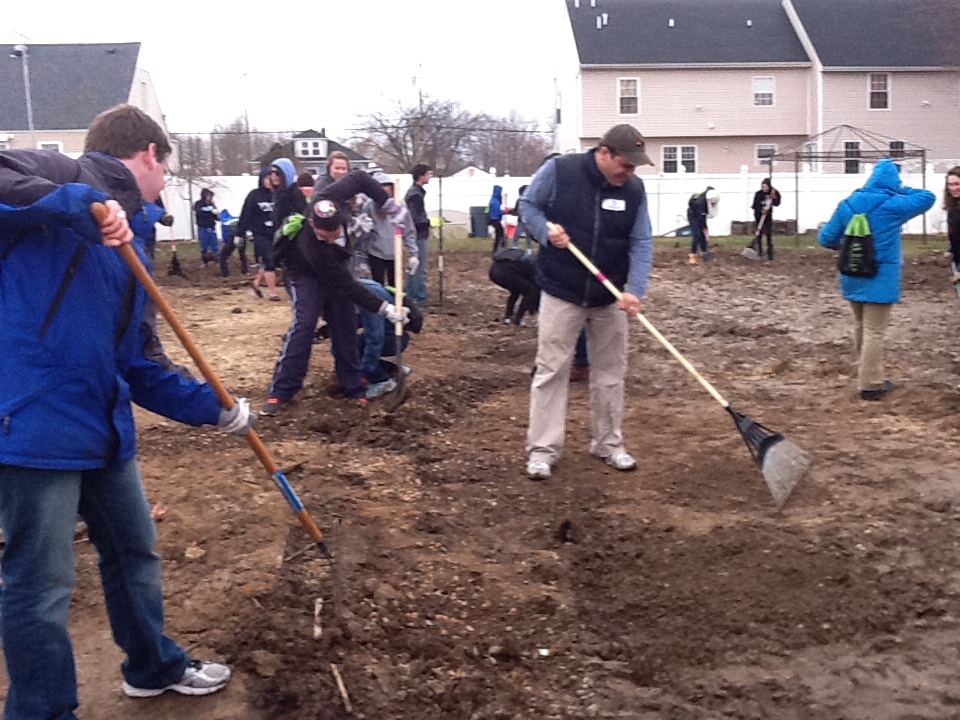
Today is Day Two of the Alternative Spring Break program of USY which organized a hands-on relief program over Chol Hamoed Pesah in order to assist in sections of New Jersey devastated by Hurricane Sandy. 
 Starting yesterday, 83 teenage USYers from 13 of the 17 USY regions came together
to do hands-on work in Union Beach, NJ, forgoing more common vacation activities and destinations. The teens will stay over in the community for Shabbat (the Jewish Sabbath) where study will center on text study about Jewish responses to natural disasters and on the importance of Tikkun Olam, which President Obama spoke about in his historic Jerusalem speech last week. The Shabbat portion of the weekend will also include communal prayer, singing and festive meals. 
Yesterday saw the teens working in rainy, windy weather with shovels, hoes and other tools in the lots of private homes in Ocean City that had been destroyed by the storm back in the fall, after they were briefed about the unique devastation to the Ocean City community. They also did park clean-up. After they finished, they went to Congregation Torat-El in Oakhurst for dinner and to hear from communal leaders, rabbis and other speakers on the dimensions of the destruction wrought by the storm. They spent the night in the synagogue in sleeping bags. The food provided for the teens is strictly Kosher for Passover. 
Today, the USYers will be working at another site from 9 am until early afternoon. The Alternative Spring Break is supported in part by Repair the World. Congregation Torat-El in Oakhurst, NJ is hosting the teens for the duration of their visit. 
Just as Rabbi Abraham Joshua Heschel famously spoke of “praying with his feet” when he marched for civil rights, I call the work of our USYers “conversing with their hands.” 
The fact that so many of our teens (and many more would have come if we could have accommodated them) chose this activity for their long-awaited spring break is proof that the lessons of the Seder are being passed on to the next generation. 
Reflecting on the values of our young people as we prepare for Shabbat, I believe we are entitled to a moment of “Dayeinu.” They have earned their place at the great Jewish communal table and we eagerly await the conversations we will share in the future. 
Shabbat Shalom and Chag Kasher v’Sameach! 

Friday, February 22, 2013

This Purim, Discover Your Inner Esther!


Among observant Jews, one of the most frequently asked questions of this past week has been: “What are you wearing for Purim?”

This question has nothing to do with fashion and everything to do with creativity as Jews have dressed up as characters from the Purim story throughout the ages in celebration of this festival. More recently, the traditional cast of characters – the Brave Queen Esther, her Noble Uncle Mordechai, the Disgraced Queen Vashti, the Dastardly Haman, the Foolish King Ahashverosh -- have given way to contemporary characters, drawn largely from popular culture or current events.


The most joyous holiday of the Jewish year, Purim celebrates the deliverance of the ancient Persian Jewish community from destruction. As told in The Scroll of Esther – written in the 4th century BCE and included in the canon of 24 holy books known as the Tanakh – the evil plot to annihilate the Jews of Persia plotted by Haman, the advisor to King Ahashverosh, was overturned by Esther, the Jewish maiden who beguiled and married the king.

However, as we approach the lighthearted festival of Purim this year – which begins tomorrow evening, at the conclusion of Shabbat -- my heart is heavy because of the recent silencing of Jewish women’s voices in Israel, lifted in prayer at one of Judaism’s most sacred sites, the Kotel.

Suppressing the voices of women is antithetical to Judaism. From our matriarch Sarah, to the prophet Deborah to Queen Esther, our tradition teaches us that women’s words are to be heeded and honored…not stamped out.

But Judaism does have a tradition of stamping out sounds that are undesirable. In synagogues around the world, tomorrow night’s recitation of The Scroll of Esther will be marked by the energetic employment of noisemakers every time Haman’s name is pronounced. This ritual is one of the most beloved and memorable of all Jewish life. Children and adults alike bring everything from the traditional wooden groggers to more contemporary implements like metal pot covers and bull horns to drown out the name of Haman, and by extension, all evil in the world.

Bearing this custom in mind, it seems that the religious authorities in Israel are confused. Instead of drowning out the name of Haman, the Chief Rabbinate has taken upon itself the task of silencing Esther.

But Purim is the holiday of reversals. Using her wiles and wisdom, Queen Esther reversed Haman’s evil plot against the Jews of Persia. In the spirit of reversal – and justice -- I propose that this Purim, we don the mask of the heroine of the holiday, Queen Esther, by honoring the voices of Jewish women.

As we endeavor to usher in an era of religious pluralism to Israel, let us access our inner Esther, pondering her bravery as we advocate for the participation of Jewish women in all realms of religious life.

Imagine if efforts had been made to silence Queen Esther, who saved the Jewish People from extinction centuries ago. What a terrible thing to envision – a world without the redemptive efforts of Queen Esther; a world without the prayers of women!

As the father of three remarkable young women, the thought is inconceivable. It leaves me, quite literally, bereft. 

This Purim, let us discover our inner Esther, drawing on the fortitude and moxie of that ancient Persian heroine to honor – not silence – brave and bold Jewish women.

photo credit: USCJ Flickr page

Friday, January 4, 2013

Deconstructing the Success of USY's International Convention: A Useful Blueprint For Our Future


 It’s hard to believe that a week has elapsed since the magic that was the 2012 USY International Convention in Boston.

NERUSY's delegation streams into
IC's Opening Session
With “God and Spirituality” as its central theme, the ruach was palpable…and incredible. Imagine more than 800 teens from around the world forming a focused fellowship, united and cohesive. USY’s International Convention was not the place for anyone seeking peace and quiet; the singing, dancing and hugging was constant. Every time I looked around I saw committed and passionate young men and women steeped in the pure unfettered joy of positive Jewish identity.

The experience was profoundly uplifting…and instructive. Here was the shimmering future of Conservative Judaism. Here were the leaders for the next generation, teaching us the essential truth that a kehilla need not have walls; indeed, that the truest meaning of kehilla transcends the concept of place.

But of course, the convention was not just one big communal hug. The programming, which culminated in an impressively well-attended rally against gun violence in America in Copley Square (drawing substantial media attention), is what made this gathering such a success. Important conversations were facilitated. In venues both large and small, USYer after USYer talked about the power of community as a safe place to explore their inner, deeper selves.

Walking through the convention sessions, I noted the most substantive discussions on God and spirituality I have ever witnessed, with any age group, anywhere.

What I observed provides a useful blueprint for a successful kehilla. At the heart of everything, a kehilla must be the convener of important, timely and relevant conversations.

To paraphrase a famous movie, build the conversation and they will come.

Some further thoughts on what worked, spectacularly: rally guest speakers Colin Goddard (an advocate for the Brady Campaign to Prevent Gun Violence and a survivor of the Virginia Tech shooting in 2007) and Pastor Corey Brooks of Project Hood (the Chicago-based activist whose Walk Across America to End Gun Violence commenced at the USCJ headquarters this past summer) were hugely inspirational, drawing the attention and respect of every USY’er.

At the rally, the reading of incidents of gun violence in each region of the country demonstrated that gun violence is a pressing, contemporary social issue – not black or white, not faith-based, not rich or poor, not limited to city or suburb.

The rally was a vehicle for empowerment and the best kind of social activism for our young people. While the incidence of gun violence, especially after the Sandy Hook massacre, is so disturbing, instead of feeling powerless to effect change, the rally gave our young people the ability to send a message to the adults that care about them – as well as those in public office – that they expect us to create a society that keeps them safe.  One after the other they shouted, “Enough is Enough!”

Furthermore, the Nativ alumni tisch-- which took place on Friday night – captured the very best of Conservative Judaism.  At this deeply moving event, 50-plus alumni of our gap-year program in Israel – who had come to staff IC -  brought the of Shabbat in Israel to the convention in Boston. It was beyond Jewish literacy; yes, they knew the words and the references to Bible and prayer in the traditional songs of Shabbat. Yes, they understood the references to creation and God’s love for humanity and Israel and the hope of redemption. They got all that and they sang in glorious harmony.

But what took place at the Friday night tisch was more than Jewish fluency or a program led by Jewish professionals. It was homegrown and real and pluralistic and inclusive. It was spontaneous and inspiring. It was a taste of Olam ha-Ba, not the distant afterlife but the immediate future – our next generation, suffused with passion and love. Modern. Engaged. Focused on fixing what is wrong in our world, united in the quest to create an Eden on earth, empowered by the gift of finding fellowship in a common vision.

What took place is replicable. Huge props to Rabbi Dave Levy, Karen Stein, Josh Ull and all our USY staffers. May the lessons of this most recent USY International Convention inspire us as we approach our Centennial celebration and beyond.

Tuesday, November 27, 2012

No Divisions Between Jews When Rockets Fly

(cross-posted at the Forward)

Like many Jewish leaders, I have devoted the majority of my professional life to advocating on behalf of my denomination. Sometimes the need is concrete, other times ideological. From supporting the worldwide network of the 600-plus Conservative kehillot to agitating on behalf of a Judaism that is pluralistic, intellectually compelling and rooted in tradition, my religious identity is often inextricable from my personal Jewish “brand.”
Much of this is unavoidable. Not a month goes by without an invitation to speak about a topic of endless fascination to the Jewish public: the current state of Conservative Judaism. Whether joining together with the heads of my sister organizations to construct a wide lens view or honing on a particular geography — I will be moderating a panel discussion on the renaissance of Conservative Judaism on Manhattan’s East Side in December — I declare myself, time and again, a spokesperson for Conservative Judaism.
But I was reminded of the limits of denominationalism this past week in the course of my hastily arranged Solidarity Tour to Israel on Day 7 of Operation Pillar of Defense. Organized by the Conference of Presidents of Major Jewish Organizations, I joined with a group of North American Jewish leaders from United Synagogue to the Union for Reform Judaism to the Orthodox Union to the Jewish Federations of North America and other Zionist groups.
Together, we visited the mayors of the cities most affected by Hamas missiles, the injured civilians and soldiers, the damaged property, the brave Israeli citizens under threat of extinction every single day. Together we met with Israeli president Shimon Peres. Together we boarded buses from Ashkelon to Beer Sheva to Jerusalem, united as Jews, representatives of our denominations, yes, but stripped of the agendas that occupy us back in our offices in North America.
We were a fellowship without boundaries because when missiles and rockets fly towards Israeli towns, they do not have addresses based on denominational affiliation. As Jews have learned from the persecutions of the past, the ideologies and practices that divide us are invisible to those who seek to erase us from the map.
Even if I can submerge my membership in a particular Jewish faction, it is impossible to silence my rabbinic instinct to turn to Torah for guidance. In Beresheet (Genesis) 1:27, humanity is created from a single being, named Adam. God creates Adam in God’s image, “male and female He created it (meaning humanity)”
A wonderful Midrash on this verse asks rhetorically – why does God create humanity from a single being? The answer rendered is – so that no one could legitimately say “my father is better than your father since we all originate from the same father.”
Though simple, this is text contains a profound lesson about unity, solidarity and the value, divinity of each and every life. As I joined together with my counterparts in North American Jewish life during our Tour of Solidarity to Israel last week, I found that this midrash came to life in a multitude of ways every day.
The most obvious manifestation was in the cross-denominational composition of our group. In a crisis, we all are Jews without divisions, united in protection of Israel. It was profound and beautiful to experience this eternal truth in the course of our trip.
We were further buoyed to note that throughout the ordeal it was enduring, Israel demonstrated how strong a society she is. People did not give up in despair. They supported their government. One clear indication of this was the better than 100% response by the reservists who were called. In Operation Pillar of Defense, the country rallied. The fight was for survival, no matter where one lived. Even during the typically divisive election time, there was unity.
It was clear that Israel applied the lessons it learned in 2006, namely, the importance of collaboration, training and readiness in various realms – civil society, political and military. When the missiles rained down on Israel, the country was ready; better yet, every segment of society worked together. The Home Front Command was so effective because people helped one another other.
That care was also manifest in the manner in which civilians were protected on both sides of the conflict, from the surgical strikes of the Israeli counteroffensive to the care on the home front. By lobbing rockets towards Gaza, the IDF adhered to the highest ethical standards, targeting terrorist sites, not people.
As we approach the joyous festival of Hanukkah, Jews of all denominations can bond in recognition of the ultimate strength of Jewish unity, at the miracles that happened in those days and in our time when we unite to fight a common enemy. In the spirit of Hanukkah, let us rededicate ourselves to this old lesson that we need to relearn in every generation: We are one people. The Jewish future depends on it.